Most agencies spend more time on the demo call than they do on the actual evaluation.
You sit through a polished presentation. The platform looks clean, the rep is likeable, the screenshots are compelling. Three weeks later you're signing. Six months after that, half your staff isn't using it and you're wondering what happened.
I've been inside enough independent agencies to know this isn't a technology problem. It's an evaluation problem. And it starts before you ever take a demo.
Here's what to look at before you commit.
Start with your workflow, not the software's promise
Every AMS is built around assumptions about how agencies operate. Most of those assumptions are close enough to cause problems without being obvious about it.
Before you evaluate any platform, map out how your agency works today. Not how you wish it worked. How it works right now.
Where does new business get tracked? Who handles renewals, and what does that process look like hour by hour? Who's responsible for carrier correspondence? What happens when a client calls with a question and the one person who handles their account is out?
Write it down. Because when a vendor walks you through their workflow, you need to be comparing it against something real instead of nodding along and hoping everything translates.
If a platform's default workflow doesn't match how your team operates day to day, you're going to spend a lot of time and money trying to reshape one of the two. Know that going in.
The people who matter most aren't in the room during the demo
This is the mistake I see most often.
The agency owner evaluates the AMS. Sometimes a producer gets pulled in. But the CSRs, the people who will live in this system for eight hours a day, rarely have meaningful input before the contract gets signed.
Ask your CSRs what frustrates them about your current process. Find out what they'd need from a new system to actually trust it. Then get them in the room for at least one demo, and let them drive.
If a CSR can't figure out how to handle the three things she does fifty times a day, it doesn't matter how good the reporting dashboard looks. The system won't get used. Or it'll get used wrong, which ends up being worse.
The CSRs are your signal. Pay attention to what they say.
Evaluate who does the implementation, not just whether it's included
Every vendor will tell you implementation is straightforward. Ask what "straightforward" means in actual weeks, with actual resources, on an actual timeline.
Ask who does the implementation. Is it the vendor's own team? A certified partner? An offshore group you'll meet on a call? Can you speak to a reference who went through it in the last year?
Get a realistic timeline. Then build in extra, because most agencies underestimate how much internal staff time implementation requires separate from whatever the vendor is doing. Your team will be cleaning data, testing workflows, approving decisions, and training on the new system while also running your agency.
That's not a knock on any platform. That's just what implementation looks like in practice. The agencies that handle it well plan for the disruption ahead of time instead of getting surprised by it midway through.
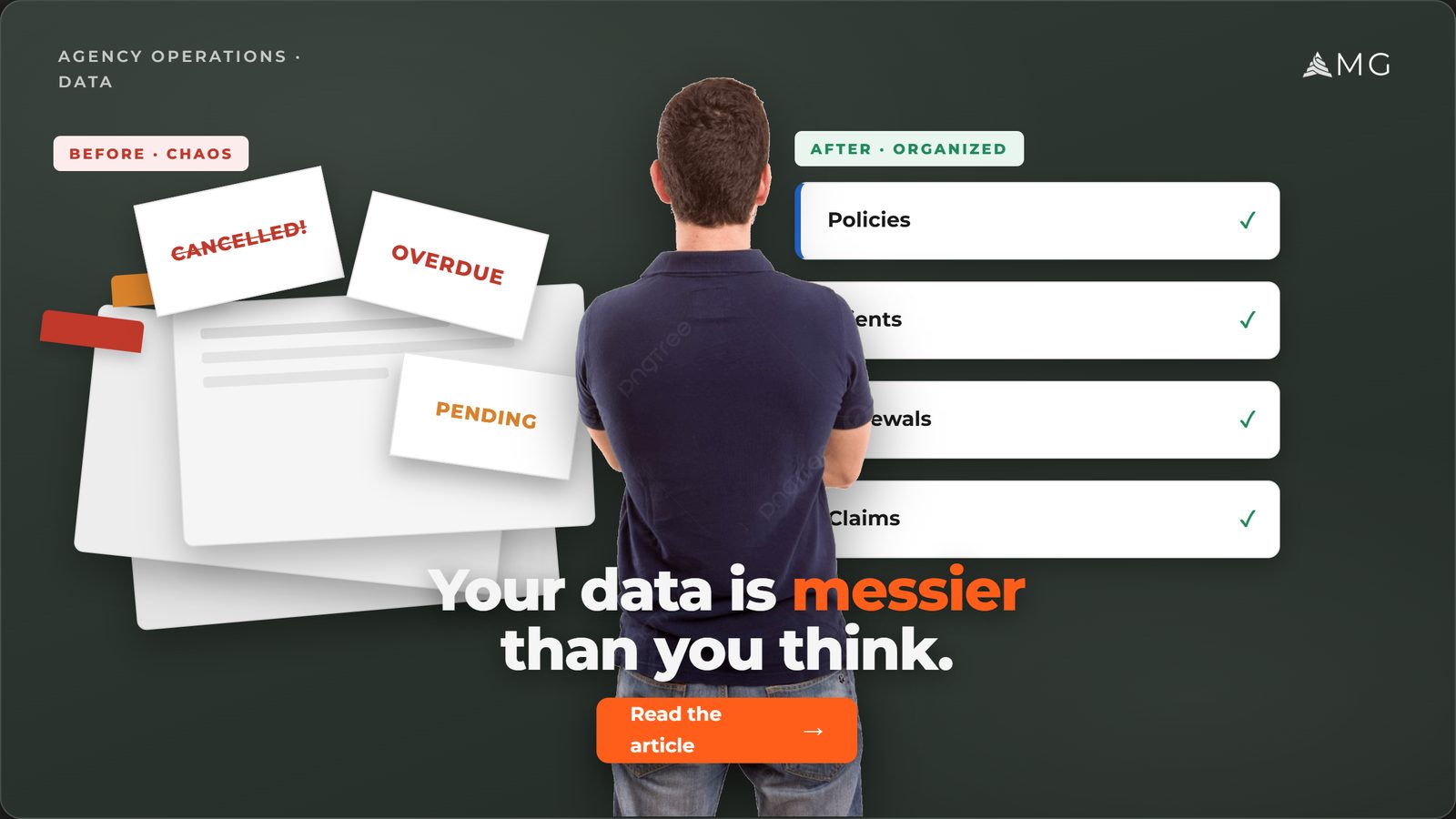
Your data is messier than you think
This one tends to catch agencies off guard.
Before any AMS conversation, pull a sample of your actual data. Policies, clients, contacts, notes, documents. Look at it honestly. Is it clean? Is it consistent? Are there duplicate client records? Are documents filed where they're supposed to be?
Most agencies find that the data cleanup takes longer than the actual implementation. That's not a crisis if you plan for it. It becomes a crisis when you don't.
Ask the vendor specifically how your data gets migrated. Who does it? What format does your existing data need to be in? What happens to records that don't map cleanly into their system structure? What gets left behind?
Get that in writing. Data migration is where a lot of implementations quietly go sideways, and by the time you notice, you're already in it.
Factor in the real cost, not the license fee
The sticker price is the starting number, not the ending one.
What's the implementation cost? Is training included or billed separately? Are there per-user fees that add up as your team grows? Is there a charge for additional integrations? What about the hours your staff will spend on implementation that don't show up on any vendor invoice?
Ask for a total first-year cost estimate, not a monthly license rate. The platforms that look most affordable sometimes have the highest real-world cost once you add everything up. The ones that look expensive sometimes include more than you'd expect.
You also need to understand what happens in year two and three. Ask whether pricing is locked or whether it increases at renewal. Some contracts have modest license fees and significant renewal escalations.
Know what it connects to before you commit
Your AMS doesn't exist in isolation. It connects to your raters, your carrier portals, your document management, your email, probably your accounting software.
Ask the vendor for a current list of their integrations. Not a roadmap. A current, live list of what actually works today. Then check it against the tools your agency already runs.
Ask specifically: how does the integration work? Is it a native connection or a middleware layer? What happens when one side updates and the integration breaks? Who's responsible for fixing it?
Integrations that work well are invisible. Integrations that break become everyone's problem at the worst possible time. Know what you're getting before you sign.
Read the contract like someone who's planning to leave
This sounds cynical. It's practical.
A platform can be a good fit in year one and a different situation in year three. Contracts matter.
What's the renewal process? Auto-renewal clauses with short opt-out windows are standard. Know when your window opens and what you have to do to exercise it.
What does it cost to leave early? What's the termination clause?
The data portability question is the one most agencies don't ask until they want to leave: can you export your data in a usable format if you decide to switch? Who owns the data? Some platforms make exit straightforward. Others make it complicated enough that agencies stay longer than they should.
Ask the vendor directly: if we wanted to leave in two years, what does that process look like? How they answer that question tells you something about how they think about the relationship.
Test support before you need it
Demo support is not real support. Every platform's demo environment runs perfectly.
Find out what support actually looks like on a Tuesday afternoon when you have a client holding and something in the system isn't working. Is there a phone number? A chat? What's the average response time? Is priority support an add-on cost?
Before you sign, ask for the actual support contact information. Send a non-urgent test question and see what happens. The response time and quality of that answer is closer to what you'll experience as a customer than anything you'll see during the sales process.
The question to ask before you sign
After all the demos, the references, the spreadsheets, the negotiations, the question that actually matters is simple: do the people who will use this platform every day actually want to use it?
Not "will they use it because you're requiring them to." Do they see how it makes their job better? Do they have enough confidence in it to give it a real chance?
If the answer is yes, you're probably making a good decision. If the answer is a shrug and a quiet sigh, that's worth sitting with before you commit.
I've seen every major AMS work well for the right agency in the right situation with the right preparation. I've also seen the wrong fit produce expensive regret that lasts longer than the contract.
Take the evaluation seriously. The right platform is out there. The evaluation process is what gets you there.
*Mitch Gibson is an independent InsurTech consultant who evaluates agency technology from the buying side. No platform affiliations. No vendor relationships. If you want a straight answer on which tools independent agencies are actually adopting, [subscribe to the newsletter](#) or [check out the podcast](#).*